Foreign Exchange for Business

UKForex offers excellent rates on foreign exchange for businesses. Whenever you make a purchase or sale which involves a foreign currency, UKForex can save you money through better exchange rates and low (or often no) fees. UKForex offers an easy and convenient system to view live rates, store your beneficiary details, lock in deals and view details of past transactions.

Having access to dedicated analysts and dealers is out of the question for most small businesses. However, UKForex provides expert dealers to discuss your foreign exchange needs and to help formulate strategies to reduce your foreign exchange risk. The UKForex system is extremely transparent and allows you to view the interbank rate and the rate you will receive. There are no commissions or hidden fees.

For a fresh approach to your currency needs, call us now to speak to one of our foreign exchange specialists. Our toll free numbers are:

Canada 1800 680 0750
United Kingdom 0845 686 1950
Australia 1300 300 524
New Zealand 0800 161 868

No Fees
On transaction amounts of GBP£3,000 and over. Click here for more details on fees.

Low Fees
On transaction amounts under GBP£3,000 (maximum GBP£7). Click here for more details on fees.

Great Exchange Rates
UKForex transacts thousands of deals per month for our vast client base. With our access to interbank markets we can pass on great savings to you in terms of super-competitive exchange rates. We will not be beaten!

Dedicated Dealer
As foreign exchange specialists, UKForex will provide you with an accredited dealer who will offer you general foreign exchange advice and clearly explain our products and services. This ensures we will find the best solution for your forex needs.

Product Range
UKForex provides an extensive range of products and services that will ensure there are no unpleasant surprises and can manage your currency payments and risks effectively. We offer spot and forward contracts, limit and stop loss orders, market advice, bulk payment and billing facilities.

Great Technology & Excellent Service
Our sophisticated dealing system puts you in control and gives you all the information you need to make your forex transfers. However, that's just part of the story. At UKForex we are dedicated to high quality, real time, personal service that is unrivalled in our industry.

Read more...

FOREX AND GOLD

Forex Update:
KARACHI, Oct 22: The Pakistani Rupee was traded at 83.70 to the US Dollar in the open market. (Bureau Report) (Updated @ 15:30 PST)

Spot rates for public per unit of currency
October 21, 2009
Countries Selling Buying Buying
T.T & O.D T.T Clean O.D/T.Chq
U.S.A. 83.4 83.2 83.02
U.K. 136.53 136.2 135.89
Euro 124.35 124.06 123.78
Canada 79.41 79.22 79.01
Switzerland 82.26 82.07 81.85
Japan 0.9189 0.9167 0.9143
Saudi Arabia 22.24 22.19 22.13
Source:-APP

Exchange Rates for Currency Notes
Countries Selling Buying
Rs. Rs.
Japan 0.9281 0.9051
Euro 125.6 122.55
U.A.E 22.93 21.01
U.S.A 84.23 82.19
S.Arabia 22.46 21.91
U.K 137.89 134.53
Source: -APP

Bullion rates in Rupees per 10 grams
on October 21, 2009
KARACHI
Gold Tezabi (24-ct) Rs 28,671
Silver Tezabi (24-ct) Rs 437.14
NOTE: Rates from Hyderabad, Lahore and Multan not received.—APP

Read more...

WORLD FOREX: Dollar Remains Stronger On Recovery Concerns

NEW YORK (Dow Jones)--The dollar remains stronger late Thursday morning as U.S. stocks slipped and disappointing U.S. economic data added to concerns over a global economic recovery.

The Institute for Supply Management, a private research group, reported Thursday that the U.S. manufacturing activity expanded more slowly last month than economists expected.

The ISM index of manufacturing activity moved to 52.6 in September, remaining above the key level of 50, anything above which indicates expansion. But September's reading was below the 54.0 figure expected by economists polled by Dow Jones Newswires.

Earlier Thursday, modest gains in U.S. personal income and spending were offset by a worse-than-expected weekly jobless report, leading the euro to hit an intraday low against the dollar before retracing some of its losses by late morning. The common currency remained down on the dollar for the day. The Dow Jones Industrial Average had slipped more than 140 points by late morning in New York.

Overnight comments by an E.U. official had sparked a euro decline, as E.U. Economic and Monetary Affairs Commissioner Joaquin Almunia said the euro group will be discussing the euro's appreciation to prepare its position ahead of the G-7 meeting in Istanbul this weekend.

That prompted a sharp sell-off, pushing the euro back under $1.46.

"Data from the euro zone continues to confirm that the economies have bottomed, but that the recovery is fragile and that the consumer is still under the pressure of rising unemployment," said Camilla Sutton, currency strategist at Scotia Capital in Toronto.

Late morning, the euro was at $1.4527 from $1.4636 late Wednesday. The dollar was at Y89.62 from Y89.75. The euro was at Y130.27 from Y131.36. The U.K. pound was at $1.5972 from $1.5990, while the dollar was at CHF1.0430 from CHF1.0369.

Currencies are likely to continue trading in tight ranges for the rest of the New York session as markets wait for Friday's September non-farm payrolls number, considered a key indicator of economic health. The payrolls number is expected to improve, but a disappointment could spook the market.

The market is "nervous" ahead of the week's remaining data, especially considering Wednesday's disappointments, Sutton said.

Meanwhile, the Brazilian real continued to show strength, though it was off its 12-month high against the dollar hit Wednesday. The dollar traded recently at BRL1.7767, from opening at BRL1.7720.

Brazil announced Thursday its foreign trade surplus narrowed in September as imports gained ground amid an expanding economy.

The Brazilian Central Bank also may increase its benchmark Selic interest rate before the end of 2009 to eliminate any inflation risks, local newspaper Folha de Sao Paulo reported Thursday.

According to the newspaper, Central Bank President Henrique Meirelles told Brazilian President Luiz Inacio Lula da Silva this week that an early rate hike might be necessary to make sure inflationary pressures don't get in the way of Brazil's 2010 economic recovery. The newspaper cited unnamed sources in its report.

Contacted by Dow Jones Newswires, central bank and presidential press officers made no comment on the report.

A signal that its central bank may increase key interest rates fuels investors funneling into the real just as much as Brazil's strong economy, said Stuart Bennett, senior currency strategist at Calyon in London.

Separately, U.S. Federal Reserve Chairman Ben Bernanke told lawmakers Thursday that the dollar's status as a global reserve currency isn't at risk in the near term, but warned that could change if fiscal deficits aren't brought under control.

When asked during Congressional testimony about comments by World Bank President Robert Zoellick that the dollar will face increasing competition as a reserve currency, Bernanke said he agrees with two points.

He agreed with Zoellick that "there's no immediate risk to the dollar, it's a relatively long-term issue," Bernanke said.

"I also agree with him, though, that if we don't get our macro [economic] house in order that that will put the dollar in danger, and that the most critical element there is long-term fiscal stability," he said.

(Rogerio Jelmayer in Sao Paulo and Tom Barkley and Maya Jackson Randall in Waashington contributed to this article.)

-By Bradley Davis, Dow Jones Newswires; (212) 416-2654; bradley.davis@dowjones.com

Click here to go to Dow Jones NewsPlus, a web front page of today's most important business and market news, analysis and commentary: http://www.djnewsplus.com/access/al?rnd=6adYHPR%2BcBp1XAN9MyupeA%3D%3D. You can use this link on the day this article is published and the following day.

Read more...

Dollar remains near 14-month low vs euro

* Dollar struggles, euro not far from 14-month high

* Analysts say Fed thought likely to keep rates low
* Market watches euro zone meeting for FX comments (Updates prices, adds comment, adds detail, changes byline)
By Nick Olivari
NEW YORK, Oct 19 (Reuters) - The dollar hovered near a 14-month low against the euro on Monday as investors bet the Federal Reserve will hold U.S. interest rates near zero well into the coming year.
Though the U.S. economy is expected to have exited recession in the third quarter, investors expect rising unemployment will keep the Fed from lifting interest rates quickly. That would diminish the dollar's appeal and encourage investors to buy higher-yielding, higher-risk currencies and assets instead.
The euro traded within half a cent of $1.50, a level not seen since August 2008.
"The dollar remains a victim of U.S. fiscal and monetary policies," said Andrew Bekoff, chief investment officer for Family Office Group in New York. "The current Federal Reserve policy remains accommodating. This serves to keep rates low and spending by the government high."
High-yielding currencies such as the Australian and New Zealand dollars hovered near multi-month highs against the greenback while U.S. earnings optimism lifted Wall Street.
The euro rose as high as $1.4965, according to Reuters data, and was last at $1.4944, up 0.3 percent from late Friday. Analysts said a test of $1.50 was still likely in the days ahead.
"The global growth story is getting better. The U.S. economy has improved, so everyone is selling dollars and buying emerging markets. The data justifies the risk," said Sebastien Galy, senior currency strategist at BNP Paribas in New York.
Traders were on the lookout for possible remarks on euro strength and dollar weakness at a gathering of euro zone finance officials in Luxembourg, although analysts said the group was unlikely to significantly talk down the euro.
"Maybe we will discuss the euro, but it's not the main focus point this evening," said Austrian finance minister, Josef Proell.
On a trade-weighed basis, the euro jumped to 118.82 on Friday, close to historic highs, though it eased to 117.00 on Monday. The euro has appreciated nearly 7 percent against the dollar this year.
YEN, AUSSIE GAIN; STERLING STRUGGLES
The dollar was down 0.3 percent at 90.63 yen and slipped 0.5 percent lower to 1.0126 Swiss francs. The Australian dollar rose 1.2 percent to $0.9267, near a 14-month peak, after a central bank official said a return to normal monetary policy was appropriate.
The Reserve Bank of Australia raised rates to 3.25 percent this month, the first major central bank to hike rates since the global economic crisis began.
Sterling climbed to a four-week high against the dollar on Monday, with market positioning, strength in global stocks and a report on the UK housing market all helping the pound claw back earlier losses.
Sterling had traded lower against the dollar and euro for most of the European session on Monday after a Bank of England policymaker said the central bank should continue its quantitative easing programme because the financial system has yet to fully recover.
Sterling last traded up 0.3 percent against the dollar atr $1.6403 GBP=>.
The New York Fed added to dollar woes on Monday when it said reverse repo tests did not mean it was ready to use this tool to drain money from the banking system. ID:nNYS005510 In a reverse repo, the Fed sells assets such as Treasuries for cash with an agreement to buy them back later, effectively tightening policy by draining money from the banking system.
The Fed has also been buying assets such as mortgage-backed debt, and some analysts said it could lend the dollar modest support by winding down those purchases while still holding rates near zero.
"Such a move would steepen the yield curve and make the dollar more attractive versus the yen on an interest rate differential basis, possibly pushing the pair to 95 yen," said Boris Schlossberg, research director at GFT Forex in New York.
Comments from Federal Reserve Chairman Ben Bernanke had little impact on currency markets.

Read more...

Gold finds new range between $990 and $1020

During the last week we saw the gold price see-saw between $990 and $1020, while the value of the dollar weakened and then strengthened and oil prices went higher and then lower. The correlation between the US dollar and the gold price is very interesting. A falling dollar usually pushes gold prices up, so when the dollar falls, gold usually rises. For instance, the dollar is down 15% in 2009, while gold is up 15% in 2009.

The one thing that caught my eye was a report by the IMF. In their semiannual report the Global Financial Stability Report (GFSR).,released on September 30, the GFSR calculates that actual and potential write downs from bad assets such as loans and securities have fallen by some $600 billion over the past six months-from about $4 trillion to $3.4 trillion, as a lessening in financial stress has narrowed spreads. Although write down estimates are subject to considerable uncertainty, the analysis shows that the financial system is on the mend. However, the GFSR estimates that commercial banks have already recognized $1.3 trillion through the first half of 2009, but face another $1.5 trillion of potential asset write downs ahead. Hence, overall, banks have recognized slightly less than half of their expected losses. U.S. banks have recognized slightly more than have those in the United Kingdom and euro area.

According to Peter Dattels and Laura Kodres of the IMF Monetary and Capital Markets Department, banks will still have to raise more capital, and that there may well be another large round of losses ahead. The global recovery, and especially the recovery in the US, has been hampered by an ongoing lack of access to credit. Another round of bank losses could make that problem worse and, in the process, tighten the credit markets again. That could break the back of an economy that is improving in very small increments.

When the U.S. Labor Department released its latest U.S. Nonfarm payroll figures for September which fell 263'000, (economists expected a decrease of 175, 000), the gold price first dropped to 987.50 offered, the day's low, before being bought straight back up as the euro gained strongly against a faltering US dollar, trading eventually back above 1.4600. Gold pushed all the way up to 1007.50 bid, the day's high. Later, the U.S. Commerce Department reported U.S. factory orders fell 0.8%, more than the 0.6% drop predicted by analysts. Gold lost some momentum and settled into trading around 1002 bid, eventually closing around $1003.

Technicals

Towards the end of August, the gold price broke to the up-side of an ascending triangular pattern, and then rallied to just under $1030. Since then, it seemed as if the price ran out of momentum and has been trading gradually lower. Technically speaking this is not uncommon, and it is possible for the price to trade back to the level of the previous resistance which is around $980. However, at this point, it could very well find major support and then begin it's next leg upwards.

Read more...

US stocks fall despite housing gains


New York - US stocks fell on Tuesday amid a drop in consumer confidence and concerns about unemployment, even as data showed housing prices soared in July by the most in four years.

Consumer confidence dropped fell to 53.1 points from a revised 54.5 in August, amid rising unemployment, the New York-based Conference Board said Tuesday.

Investors were also concerned about September unemployment figures that are due out Friday. The US unemployment rate jumped to 9.7 per cent in August, soaring to a 26-year-high, as employers slashed an additional 216,000 jobs.

Read more...

Pak Rupee weaker against dollar

Local currency market was closed for three days from September 21 to 23 on account of Eid-ul-Fitr celebrations.

When the market opened on September 24 it was still in festival mood. The rupee-dollar parity rates moved both ways amid higher demand for greenback. On the inter-bank market the rupee posted fresh gain of five paisa against the dollar which traded at Rs82.95 and Rs83. after closing the previous week at Rs83 and Rs83.05.

The rupee did not show any change against the dollar on the last trading day of the week in review as the dollar continued to trade at its overnight level on September 25. However, the dollar in the inter-bank market has gained Rs4.80 in relation to rupee in the past 12 months. The parity was changing hands at Rs78.15 and Rs78.20 September 26 last year.

In the open market, the rupee commenced the week on negative note amid hectic buying of dollar as market reopened after celebrating Eid. Due to higher demand for dollar, the rupee came under pressure and shed 15 paisa against dollar, changing hands at Rs82.85 and Rs82.95. The rupee had closed previous week at Rs82.70 and Rs82.80.

On September 25, there was no gap in the inter-bank and open market rates of dollar as it was trading at Rs82.90 and Rs83.00 after the rupee shed five paisa versus dollar on the last trading day of the week in review.

This week, the rupee in the open market lost 20 paisa against the dollar due to rise in dollar demand in the last trading session. Over the past 12 months however, the rupee in the open market has lost Rs4.70 against the dollar on the buying counter and another Rs4.40 on the selling counter. The dollar was trading in the open market at Rs78.20 and Rs78.60 on September 26 last year.

Versus the European single common currency, the rupee opened the week on dismal note, losing 65 paisa to trade at Rs121.30 and Rs121.80 on September 24 after closing at Rs120.65 and Rs121.15 in the previous week. The rupee, however, managed to gain 38 paisa versus euro on the buying counter and another 40 paisa on the selling counter September 25 when it was changing hands at Rs120.92 and Rs121.40 following persistent rise in the international market. During the week in review, the rupee managed to gain 27 paisa against euro on the buying counter and 25 paisa on the selling counter. However, it has lost Rs7.32 on the buying counter and Rs7.70 on the selling counter in the past 12 months when euro was trading at Rs113.60 and Rs113.70.

On the international front, the dollar climbed broadly on the opening day of the week, hitting a near two-week high against the yen in New York as investors reduced bets against the greenback ahead of a monetary policy meeting by the Federal Reserve this week. The dollar rose more than one per cent against the yen after speculative flows pushed it higher, though the gains were subsequently pared. Trading in Asia was quiet as financial markets in several major markets were closed for local holidays.

In late New York trading, the euro slipped 0.2 per cent to $1.4672, easing from $1.4766 hit late last week, which was its strongest since September 2008, according to Reuters data. Against the yen, the dollar was up 0.8 per cent at 92.04 yen, near a peak of about 92.53 yen, its highest since Sept. 9. Against the dollar sterling was down 0.6 per cent at $1.6175, near $1.6134 hit earlier in the day for its weakest level in nearly three weeks.

On September 22, the dollar dropped broadly hitting a one-year low against the euro as optimism about a global economic recovery dented safe-haven demand ahead of a Federal Reserve meeting and Group of 20 summit this week. Traders took advantage of a dollar rally in the prior session to sell on views the Federal Open Market Committee will signal plans to maintain loose monetary policy well into 2010 to promote the recovery.

In late trading, the euro was up 0.8 percent at $1.4796 after options-related demand and strong Asian buying pushed it above $1.48 for the first time since September 2008. With no major economic data on the calendar, traders said $1.4825 may be the next target in euro-dollar, with many predicting an eventual move back to $1.50. The dollar fell 0.9 per cent to 91.14 yen and 0.8 per cent to 1.0231 Swiss francs, near a 14-month low touched earlier. Sterling rose 1 percent to $1.6359. The euro rallied to a year-high against the dollar, rising as high as $1.4821.

On September 23, the dollar rebounded from a one-year low against the euro as US stocks reversed gains sparked by an optimistic statement from the Federal Reserve on the economic outlook. The dollar had earlier sold off after the Fed said US economic activity had picked up after a severe downturn and renewed its pledge to keep rates exceptionally low for an extended period to support the recovery.

The euro rose as high as $1.4842, according to Reuters data, its highest level since September 2008. It last traded down 0.4 per cent at $1.4728. The dollar rose 0.2 per cent to 91.34 yen. Sterling rallied more than half a percent on the day to a session high of $1.6456, having jumped a full cent soon after the minutes were released. It traded at $1.6402, up 0.3 per cent on the day.

On September 24, the euro was down 0.5 per cent at $1.4650, off a session high of $1.4803 and a one-year peak of $1.4842 hit a day ago. The dollar was little changed at 91.23 yen, though that was well off a 90.36 session low. The euro was risen five per cent against the dollar this year. Sterling fell 1.8 per cent to $1.6049, dropping below $1.61 for the first time since July.

At the close of the week on September 25, the euro edged up 0.2 per cent to $1.4690 after falling as low as $1.4614 earlier in the day. The dollar fell 0.8 percent against the yen to 90.57 yen as the Japanese currency rose broadly, helped partly by its sharp gains versus the pound. Sterling slid further to a four-month low against the dollar as a break of major support levels triggered a wave of stop-loss sales. The pound extended its slide, falling below major support at $1.60. It dropped as low as $1.5917, its lowest since early June, before edging back to $1.5989, down 0.4 per cent on the day.

Read more...

Commercial Banks

In the world of Foreign exchange market, the maximum control is in the hands of huge multinational banks and organizations. This is because of the fact that their everyday degree of actions of trading and market cross over billions of dollars. With such a huge figure in their hands, it would not be wrong to say that these commercial banks use up an indispensable amount of exchange transactions. The banks can be said to gather through all their clients, the growing and collective wants of the market for currency exchange. Also, in addition to agreement of clients’ purposes, the banks can sometimes trade for their own operations for their own means too. Some of the well known international banks which are successfully involved with Foreign Exchange are Chase Manhattan Bank, Deutsche Bank, Citibank, Standard Chartered Bank and Barclays Bank to name a few. Their huge quantities of transactions can lead to noteworthy alterations in the currency rates. Mostly these big commercial banks are divided into Bulls and Bears. Bulls Bulls are those Forex market members who are concerned with the escalating of currency rates.Bears Bears are those Forex market members who are concerned with the depression of the currency rates.

Read more...

Aussie Further High on Retail Sales

Australian dollarThe Australian dollar extended its record high after a report indicated that retail sales grew for the first time in three months, providing support for speculations that the South Pacific nation will raise interest rates before the end of the year.

The Aussie is the best performing currency among the 6 majors in 2009 due to the country’s resilience from the global slump which affected other regions, specially North America and Europe more than the South Pacific. This week, the Australian currency found support to extend its rally as retail sales climbed for the first time in three months, making the current September the biggest winning streak for the Aussie in a month in a quarter of century as the chances of rate hikes emerge in Australia by the day, with an eventual shift in the Reserve Bank of Australia policy to be expected as soon as November, making the South Pacific nation the first country to raise interest rates after the global slump struck the world last year.

Market sentiment towards the Australian currency remains strong and positive, according to analysts. The retail sales figures added to an already very optimistic outlook for the Australian economy, and the Aussie is unlikely to decline significantly before the end of the year, at least.

AUD/USD traded at 0.8794 as of 7:06 GMT from 0.8739 in the intraday comparison. AUD/CAD traded at 0.9491 from 0.9478.

Read more...

Commodities Push Brazil’s Real to One-Year High

Brazilian RealOptimism returned to markets today affecting negatively currencies like the yen and the dollar at the same time that emergent market currencies, like the Brazilian real, witnessed a rally today, as commodities climbed worldwide.

The Brazilian currency managed to touch the highest rate in a year as a renewed demand for commodities increased the price of Brazil’s main exports, consequently providing support for the real to grow together with other emergent market currencies versus lower-yielding majors in foreign-exchange markets.

USD/BRL traded at 1.7805 as of 21:25 GMT from an opening price of 1.7945.

Read more...

Canadian Dollar Roses Sharply on Commodities


Canadian DollarThe Canadian dollar, one of the most dependent currency to stocks and commodities, climbed significantly today as optimism pushed the crude oil and gold rates up, suggesting that the global economy will improve demand for Canadian exports.

The loonie, as the Canadian dollar is often referred, witnessed a significant rally today being the sharpest climb in September provoked by optimism that increased risk appetite among traders as commodities rose and the International Monetary Fund cut its forecast for global economic declines, adding to the already positive sentiment in trading markets today.

USD/CAD traded at 1.0675 as of 21:56 GMT from a previous rate of 1.0855 yesterday.

If you want to comment on the Canadian dollar’s recent action or have any questions regarding this currency, please, feel free to reply below.

Read more...

Swiss Franc Drops; SNB Has No Comment

NEW YORK (Dow Jones)--The Swiss franc dropped sharply in intraday trade against the euro and dollar amid fears the Swiss National Bank might intervene in currency markets.

The Swiss National Bank has declined to comment.

The euro abruptly swept up from the CHF1.5145 area to hit an intraday high of CHF1.5201. It has since settled back at around CHF1.5158.

The dollar gained from CHF1.0407 to CHF1.0466. It too has declined some since and is trading near CHF1.0439.

Within the last 24 hours, analysts said the Swiss franc's trade-weighted index, which is comprised of the euro and dollar, was close to the level at which the SNB last intervened in late June.

The SNB has been intervening periodically in the foreign exchange market since March to contain advances in the Swiss Franc to protect the country's exporters and fight deflation.

Late last month, with the euro trading at around CHF1.52, SNB member Thomas Jordan said the central bank "won't accept further strengthening of the Swiss franc."

Traders always watch carefully when the euro sinks to the CHF1.5150 area as that is widely seen as the edge of the SNB's tolerance.

Currency strategists added that there isn't a lot of conviction in the market, but there is a lot of anxiety. This is causing significant currency-market volatility.

While the euro's move was significant compared to intraday action, on a day-to-day basis, it is not notably higher. Wednesday, it was at CHF1.5166 late in the New York session.

Thursday morning in New York, the euro was at $1.4531 from $1.4551 late Wednesday, according to EBS via CQG. The dollar was at Y91.90 from Y92.08. The euro was at Y133.56 from Y133.90. The U.K. pound was at $1.6635 from $1.6535, and the dollar was at CHF1.0429 from CHF1.0425.

The euro also fell to a session low against the dollar, reversing an earlier rally to a fresh nine-month high of $1.4608.

The common currency fell as low as $1.4502.

Other than volatility and uncertainty, strategists said the euro may have come under pressure on concerns that the SNB could buy dollars in a potential intervention, affecting the euro exchange rate against the dollar.

Back in June, traders saw the SNB buying dollars on the Electronic Broking System, or EBS.

Read more...

Yen Extends Rally To 7-Month High Vs Dollar

NEW YORK (Dow Jones)--The yen extended its recent rally Friday, marking a fresh seven-month high against the dollar.

The yen also advanced to a one-week high against the euro, as it broke closely watched levels against the dollar that drove traders to buy Japan's unit.

The next level eyed for the dollar is Y89.80, a break of which could send the dollar tumbling again.

"We continue to view the yen as likely to surprise," said analysts at Credit Suisse.

They forecast that a recovery in global production will support Japan's exporter revenue and increase foreign demand for Japanese equities. In addition, interest rates for major currency rivals are "too low" to attract local investors out of Japan.

Friday afternoon in New York, the euro was at $1.4582 from $1.4584 late Thursday, according to EBS via CQG. The dollar was at Y90.64 from Y91.70. The euro was at Y132.21 from Y133.73.

UBS said the Bank of Japan may have to tackle the issue of a strong yen at its policy meeting next week.

Meanwhile, the U.K. pound was at $1.6677 from $1.6658, while the dollar was at CHF1.0372 from CHF1.0385.

The dollar has been broadly weaker, sold on dropping long-term U.S. interest rates, which signal the market expects the Federal Reserve to keep the yield on the U.S. currency at very low levels well into next year.

Data from the British Bankers' Association showed three-month dollar Libor, an important gauge of the effectiveness of the Fed's monetary policy, slipped to 0.299% from Thursday's 0.29969%, albeit above the record low of 0.29869% seen Wednesday.

"The move has been so rapid," said Hidetoshi Yanagihara, a currency strategist at Mizuho Corporate Bank in New York. "Rates are coming off much faster than the market thought," he said, leading traders to sell the dollar.

The mid-point for Japan's fiscal year may also be leading to some repatriation into the yen, said analysts.

While the euro advanced to a fresh nine-month high of $1.4636 Friday, intraday volatility in equities and crude-oil markets, as well as profit-taking and the expiration of options contracts, undercut those gains.

Positive U.S. data also provided some momentary support for the U.S. unit.

The Reuters/University of Michigan preliminary consumer sentiment index for September gained to 70.2 from 65.7 in August, compared with economist expectations for a reading of 67.5.

But Barclays Capital and other institutions believe the dollar has further to fall in the near term.

Currency positioning among private and official investors isn't yet at extreme levels that they would require a bounce back, according to Barclays.

Read more...

Euro Continues Gains On Eased Trade Fears

NEW YORK (Dow Jones)--The euro gave up some of its gains after hitting a nine-month high against the dollar Monday, but it still remained higher on the day as risk appetite continued to drive markets.

Concern over a trade dispute between the U.S. and China had led investors back to the safe-haven dollar overnight, causing the euro to open New York trading down on the U.S. currency. The dollar had been under pressure since the euro broke through its summer ranges after the U.S. Labor Day holiday early last week.

But worries over the dispute lifted somewhat after China filed a complaint with the World Trade Organization over a U.S. tariff on Chinese tires, as opposed to issuing unilateral counter-tariffs, analysts said.

"The first fears that hit the market were that maybe this dispute was going to become something much bigger; those fears have kind of dissipated," said Steve Englander, chief currency strategist at Barclays Capital in New York.

That sent investors back to a "risk-on" strategy, propelling the euro to a nine-month high of $1.4654, before the common currency retreated towards $1.46 in late afternoon trading. U.S. stock markets were up modestly Monday.

Commodity-based currencies, such as the Australian dollar and Canadian dollar, remained shaken by the possibility of a trade disruption, analysts said.

The Canadian dollar was hit "because of [the trade dispute's] potential impact on the global recovery and due to fears of the effect of increasing U.S. protectionism on Canadian exports to the U.S.," said currency strategist Camilla Sutton of Scotia Capital in Toronto.

The dollar was at C$1.0834, after stretching as far as C$1.0925 earlier in the session, its highest level against the Canadian currency in more than a week.

Late Monday afternoon in New York, the euro was at $1.4612 from $1.4582 late Friday, according to EBS via CQG. The dollar was at Y91.00 from Y90.64. The euro was at Y132.98 from Y132.21. The U.K. pound was at $1.6562 from $1.6677, while the dollar was at CHF1.0355 from CHF1.0372.


To see the dollar's move against the Canadian dollar, please see:

http://dowjoneswebservices.com/chart/view/2783


Investors Tuesday will be paying close attention to U.S. retail sales figures for August, which are scheduled to be released at 8:30 a.m. EDT. Retail numbers are expected to improve from July. Analysts said the data could move currencies.

If the numbers come in as expected or better, risk appetite should strengthen, lending support to the euro. If the numbers disappoint, investors could again turn to the safe-haven dollar on fears of a stalled economic recovery.

"A weaker number will give grist to those who think this risk rally has run its course and that, ultimately, we're looking at a pretty weak recovery," said Brian Dolan, chief currency strategist at Forex.com in New Jersey.

Traders will be watching a key technical level for the euro at $1.4575.

"As long as we stay above there, we'll probably stay pretty firm," said Andrew Chaveriat of BNP Paribas in New York.

Read more...

Poland’s Economic Outlook Provide Support for Zloty

Polish zlotyThe Polish currency extended last week’s gain this week as the Eastern European nation is showing one of the quickest recoveries in the region, increasing attractiveness for the zloty regionally.

After growing beyond economists expectations for the last quarter, Poland is being considering one of the most solid economies in the region, fact which is favorable for the zloty to gain versus several currencies, but mainly against the euro as the Polish currency suffered a severe devaluation during the worse moments of the global slump. The Polish currency climbed for a second week in a row on the country’s economic outlook.

EUR/PLN closed at 4.0923 from a previous rate of 4.1162 yesterday.

Read more...

Rating Downgrades Drop Icelandic Krona

Icelandic kronaThe Icelandic krona declined to the lowest level in almost seven years against the U.S. dollar yesterday after the rating downgrades by S&P and Fitch rating agencies raised the risk-averting mood among the investors.

The drop in this national currency reached more than 17 percent this week after the central bank pledged to nationalize the century-old Glitnir Bank as it failed to pay by its short-term debts. Investors believe that the central bank won’t be able to help all the banks and the country will face a strong financial crisis.

The USD/ISK is rising for the sixth day in a row now — the longest rally in more than 3 months. Traders lose confidence in the financial system, the Central Bank of Iceland and its ability to resist crisis. That plays against the krona’s value.

USD/ISK rose from 108.16 to 111.29 as of 13:12 GMT today. It reached 111.51 rate yesterday — the highest rate since November 2001 after closing at 94.35 at the last week’s trading session.

Read more...

Czech and Polish Central Banks Leave Rates Unchanged

Czech National BankAfter two other European central banks decided to hold their current interest rates, Czech and Polish banks chose to follow the same way and didn’t change their reference interest rates despite the fact that they both raised the rates at the end of November.

Today both central banks had their scheduled monetary policy meetings at the same time at 2 p.m. GMT. Czech National Bank left rate at 3.50%, National Bank of Poland – at 5.00%. Central banks of Sweden and Hungary held their interest rates earlier too. ECB left the rate unchanged after its last meeting on Devember 6.

The fact that four European central banks decided to follow ECB rate decision may mean only that European Union is facing a hard time both from the side of rising inflation and from the side of the slowing economic growth. Inflation matter is caused by the high oil prices that drive prices for other goods up; GDP output slowdown is attributed to the bank sector turmoil and the over-expensive euro (compared to dollar and yuan).

It is very probable now for the other European central banks (Norwegian, Danish, Slovakian, Latvian) to leave their rates unchanged. They will wait for the balance of growth/inflation to move into any direction before taking some preventive actions or continuing general monetary policy.

Read more...

Yuan Falls as China Doesn’t Want Appreciation

Chinese yuanThe Chinese yuan declined at a fastest pace during the last two months as the country’s central bank lowered the reference exchange rate to stimulate the exporting industry.

The China’s yuan lost about 0.1 percent during one day today after the People’s Bank of China fixed the reference exchange rate of the yuan to the U.S. dollar at 6.8285 — down by 0.07 percent compared to the previous rate. China uses the regulated foreign exchange rate to keep the yuan from appreciating too fast and thus helps the domestic companies compete globally.

U.S. Treasury Secretary Timothy Geithner will start his visit to China on June 1. The aim of the visit is to discuss trading relations and Geithner will probably insist on the fast yuan’s appreciation. The previous visit of the Treasury Secretary (Henry Paulson at that time) was in early December 2008.

Analysts say that the latest downward reference rate change means that the monetary authorities in China don’t plan to float the yuan’s exchange rate and won’t allow its appreciation. The economic growth is still a priority for China after the slowest gain of GDP in almost ten years in the first quarter.

USD/CNY advanced from 6.8235 to 6.8307 as of 7:40 GMT today. The highest intraday rate was set near 6.8309.

Read more...

New Zealand Dollar – Victim of Carry Trade

New Zealand dollarWhile the Japanese yen is surely a benefiting currency when it comes to the carry trade panic, some currencies feel extremely bearish at the times of global financial instability and other factors that bring down risk appetites. New Zealand dollar is one such currency.

Carry trade is a global trend in the high-yielding investment industry, where traders buy high-risk currencies such as South African rand and New Zealand dollar, that has a very high interest rate, with a cheaper currency such as Japanese yen, which costs just 0.5% a year to borrow.

Popularity of the carry trading contributed a lot to the past years of the NZD growth. Traders could earn not only from the huge interest rates difference between New Zealand and Japanese Central Banks, but also from the growing appreciation of the high-yielding currencies. Carry trade has been growing into a enormous bubble for almost 4 years. And it looks like the time for its bursting has come.

The financial crisis based on the subprime lending crash triggered massive buying of the Japanese yen, as the investment safe haven. Strong demand for yen started to outweigh its offer from the carry trade speculators and it started to grow against riskier currencies. Rising yen began to trigger stop-loss orders of the carry traders, accelerating the yen growth. So, combination of global financial instability and the carry trade stop-losses caused a real rally for the low-yielding currencies.

Too bad for the high-yielders, such as the New Zealand dollar, there is a very high probability of their depreciation, which if left unstopped can inflict damage to many world economies.

Read more...

Brazilian Real Rebounds from August Lowest Rates

Brazilian RealThe Brazilian currency touched the weakest level in August today on global economic concerns but rebounded after stocks and commodities climbed worldwide, spurring demand for emergent markets assets.

After several days of bearish market on Chinese limitations towards steel and cement production, today equities markets worldwide rebounded, causing a domino effect that provide support for commodities to climb, influencing emergent market currencies like the Brazilian real up, which rebounded after touching the lowest rate in August today.

USD/BRL traded at 1.8620 as of 22:31 GMT after hitting 1.8885 hours earlier

Read more...

Australian Dollar Hits Two-Week High on Stocks

Australian dollarThe Australian currency, often referred as the Aussie, strengthened to a two-week high versus the yen as stocks in Asia climbed this Monday, raising attractiveness for the yield of the Australian dollar.

The Australian dollar had a brilliant performance last week supported by U.S. corporate earnings, and this week, both the Aussie and its New Zealand counterpart started bullish mainly against the yen and the greenback, as commodity prices continued on the rise, favoring the attractiveness of the South Pacific currencies. The return of risk appetite among investors made Australia’s S&P/ASX 200 Index to advance for the fifth day in a row, and since commodity exports account for more than half of Australian foreign trade, the crude oil rise together with several other commodities pushed the Aussie up to hit a two-week high versus the Japanese yen, which is losing massively since risk aversion declined.

The fact that corporate earnings and several reports in the United States came better than what most of economists predicted pushed confidence among traders to return to high-yielding assets intensively. The Australian dollar lost significantly versus the yen two weeks ago, and the current market scenario is the perfect opportunity for traders to profit as the Aussie rebounds.

AUD/JPY climbed to 76.89 as of 11:34 GMT from an opening price of 75.75. AUD/USD followed, being traded at 0.8124 from 0.8055.

Read more...

Australian Dollar Climbs on Employment Data

Australian dollarThe Australian dollar is being traded today near a 10-month high as job figures in the country came unexpectedly positive, adding confidence that the South Pacific region will be one of the first global economic areas to find its way out of recession.

The forecasts regarding the Australian job market pointed to a consistent decline in the number of employed people, which were proved to be false, as today, a national employment report indicated a rise in jobs, making the Australian dollar to climb for the fifth day in a week versus its U.S. counterpart. The Australian dollar is being one of the best performing currencies among the 16 most traded, as speculations indicate that the country is likely to be one of the first to increase its benchmark interest rate, a fact that is attracting a significant amount of traders to purchase assets in the South Pacific region.

The unexpectedly favorable employment data in Australia helped the Aussie to keep its levels very high, as weakened figures would push the Aussie down favoring a corrective movement after several days of gains. The Australian currency is likely to continue its uptrend, as risk appetite stills very broad among traders, favoring the main South Pacific currencies.

AUD/JPY traded at 80.389 as of 10:45 GMT from a previous rate of 79.625 yesterday. EUR/AUD fell from 1.7175 to 1.7089.

Read more...

Australian Dollar Down on Chinese Negative Data

Australian dollarThe Australian Dollar lost today against several currencies like the yen and the U.S. dollar after a negative report in China pushed investors back to safer assets, damping demand for the Aussie’s riskier profile.

The Australian currency lost the most in a week today after Chinese banking data came worse-than-expected by economists, showing a slide in new lending figures and a disappointing rise for fixed-assets investments, indicating that one of the main global economies may still face further months of recession. The New Zealand dollar as well as its Australian counterpart are considered high-yielding currencies despite the current low interest rates in both countries, and these negative reports in China affected the Aussie and the kiwi today, paring much of last week’s gains versus the yen and the greenback.

Economists affirm that last week’s euphoria stimulated forecasts to be set higher, and the Chinese numbers today frustrated most of traders, which were attracted to refuge currencies like the U.S. dollar and the Japanese yen to provide more safety to their portfolios. The currency market tends to remain very volatile until the global economic conditions remain uncertain, and it is hard to predict what direction high-yielding currencies will take towards the end of the year.

AUD/JPY fell to 80.73 as of 10:54 GMT from a previous rate of 81.70 in the intraday comparison. AUD/USD followed the same trend from 0.8417 to a current price of 0.8363.

Read more...

Pound Declines on U.K. Economic Figures

Great Britain poundThe pound posted another day of losses versus most of the 16 main traded currencies as the economic situation in Great Britain remains behind most of the other main global economies, decreasing attractiveness for the British currency.

Today’s published data and tomorrow’s forecasts are once again impacting the pound which is posting the sixth consecutive day of losses versus the euro, since U.K.’s economic outlook is currently far more negative than the Eurozone’s perspectives. Today, the German Ifo business climate came positive beyond expectations, helping the euro to climb to the highest level in almost 3 months versus the British currency, and this trend is likely to follow as tomorrow, a U.K. house prices report is expected to bring rather disappointing numbers, which would weigh on the pound even further.

Currency specialists forecast a rather complicated short-term future for the U.K. currency as other economic regions throughout the world, like the South Pacific and North America, are providing more consistent signs of recovery than the pound country, which is certainly decreasing attractiveness for the British currency, causing a mass capital outflow from pound-priced assets towards more attractive bets throughout the financial world. The pound is likely to remain bearish, until more optimistic reports start to appear in the United Kingdom.

EUR/GBP climbed to 0.8783 as of 11:02 GMT from yesterday’s rate of 0.8728. GBP/USD traded at 1.6279 from 1.6390.

Read more...

Pound Declines on Disappointing Manufacturing Numbers

Great Britain poundThe pound declined today versus the most of 16 main traded currencies after a report in the country indicated that manufacturing production declined beyond economists expectations, adding pessimism concerning the recession length in the United Kingdom.

The United Kingdom has indicated through its latest economics reports that the current recession in the country can be considered more serious if compared to most of the main relevant economic regions around the world, declining appeal for the pound’s outlook, which traded today in the lowest level versus the euro in two months. Today, a manufacturing report published in Britain came below 50, indicating a contraction and going against expectations, sice most of economists were expecting a positive performance fueled by the to-be-confirmed economic revival in Europe. Following the pound’s decline, stocks in Britain also declined, indicating a flow of capital out of the British Isles.

Analysts evaluate the current fundamentals in the United Kingdom as negative factors weighing on the pound’s performance, since Bank of England’s policies are being unable to revive the nation’s economy, raising concerns that the recession will be longer and deeper in the U.K. than previous forecasts, which is certainly decreasing attractiveness for the British currency.

GBP/USD traded at 1.6214 as of 12:58 GMT from a previous rate of 1.6313 in the beginning of the day. EUR/GBP is in its highest rate in more than two months being traded at 0.8825.

Read more...

German Business Sentiment Fuels Euro Rally

EuroAfter a rather mediocre start in the beginning of this week the euro had a positive performance today as German business sentiment rose again suggesting that the Eurozone member countries are finding its path out of recession.

The German Ifo business climate index climbed beyond economists expectations this morning as confidence is rising towards the country’s economy, fact which brought the euro to the highest level in almost 3 months versus the United Kingdom’s currency, nation which is posting less expressive signs of revival if compared to the wealthiest nation among the Eurozone members, Germany. Renewed optimism today also formed bullish patterns in commodity charts, favoring currencies like the Norwegian krone, since the Nordic nation is one of the main providers of oil for the European Union.

Analysts stress on the fact that German economic numbers are the main drivers of euro appreciation versus the pound, since Germany is by far the strongest economy in the bloc, followed by France. As signs of recovery become more evident, volatility among the euro and other main currencies tend to decrease, but the United Kingdom is still dealing with a deeper recession, fact which provide support for the euro to gain even further versus the faltering British currency.

EUR/GBP traded at 0.8775 as of 9:40 GMT from an intraday rate of 0.8727.

Read more...

Poland’s Economic Outlook Provide Support for Zloty

Polish zlotyThe Polish currency extended last week’s gain this week as the Eastern European nation is showing one of the quickest recoveries in the region, increasing attractiveness for the zloty regionally.

After growing beyond economists expectations for the last quarter, Poland is being considering one of the most solid economies in the region, fact which is favorable for the zloty to gain versus several currencies, but mainly against the euro as the Polish currency suffered a severe devaluation during the worse moments of the global slump. The Polish currency climbed for a second week in a row on the country’s economic outlook.

EUR/PLN closed at 4.0923 from a previous rate of 4.1162 yesterday.

Read more...

New Zealand Dollar Falls on Central Bank Governor Interview

New Zealand dollarThe New Zealand dollar started this week losing versus the greenback and the yen as higher-yielding currencies attractiveness declined while risk aversion grew among traders globally, shunning investors from assets in the South Pacific region.

After a radio interview in which Allan Bollard, Reserve Bank of New Zealand Governor, stated that a strong kiwi is affecting the nation’s exports performance, the New Zealand currency declined versus most of the 16 main traded currencies, also influenced by a negative performance in Asian stock markets, mainly in China, where the Shanghai Composite Index declined more than 6 percent, decreasing attractiveness for the relatively riskier trading options in New Zealand and Australia.

A decline in the kiwi rates will be extremely favorable for New Zealand’s economic recovery, according to specialists. The bullish patterns perceived in the last two months for the New Zealand currency may delay the recovery in the South Pacific nation, as a strong currency declines competitiveness for a country’s products, but as long as volatility remains high, with multiple reports proving support for contradictory speculations, it will be difficult to determine how well the kiwi will perform, as well as the New Zealand economy as a whole, considering its export-oriented profile.

NZD/JPY traded at 63.45 as of 10:54 GMT from an opening rate of 63.74 yesterday. NZD/USD followed the same trend, being traded at 0.6839 from 0.6815.

Read more...

Pound Declines on Disappointing Manufacturing Numbers

Great Britain poundThe pound declined today versus the most of 16 main traded currencies after a report in the country indicated that manufacturing production declined beyond economists expectations, adding pessimism concerning the recession length in the United Kingdom.

The United Kingdom has indicated through its latest economics reports that the current recession in the country can be considered more serious if compared to most of the main relevant economic regions around the world, declining appeal for the pound’s outlook, which traded today in the lowest level versus the euro in two months. Today, a manufacturing report published in Britain came below 50, indicating a contraction and going against expectations, sice most of economists were expecting a positive performance fueled by the to-be-confirmed economic revival in Europe. Following the pound’s decline, stocks in Britain also declined, indicating a flow of capital out of the British Isles.

Analysts evaluate the current fundamentals in the United Kingdom as negative factors weighing on the pound’s performance, since Bank of England’s policies are being unable to revive the nation’s economy, raising concerns that the recession will be longer and deeper in the U.K. than previous forecasts, which is certainly decreasing attractiveness for the British currency.
GBP/USD traded at 1.6214 as of 12:58 GMT from a previous rate of 1.6313 in the beginning of the day. EUR/GBP is in its highest rate in more than two months being traded at 0.8825

Read more...

Negative Week for Canada’s Currency as Risk Aversion Rises

Canadian DollarThe Canadian currency entered its third day of consecutive losses as a new intense wave of risk aversion is creating bearish patterns in the main two loonie’s vectors, the crude oil and stocks.

After touching the highest rate in more than 10 months in June, the Canadian currency did not manage to sustain its high levels as towards the end of August and now in the beginning of September stocks declined and demand for commodities faltered, influencing negatively the performance of the Canadian dollar.

USD/CAD traded at 1.1046 as of 18:28 from a previous rate of 1.0938 in the intraday comparison.

Read more...

U.S dollar: Looking For The Line of Least Resistance

As housing continues to improve, unemployment could rise again in the coming months. In Germany, confidence is growing, while the economy might take advantage of global growth.


U.S.: housing is back?

Unemployment remains the biggest challenge for the U.S. economy, despite losses declining to 220,000 from 247,000 in July. In reality, we are experiencing the lowest job contraction in more than a year, but the unemployment rate could again rise due to the slow recovery in the last part of 2009. At the contrary, the real estate market is confirming the good trend and it is expected to positively contribute to the Gross Domestic Product (GDP) numbers, along with inventory growth for various goods. In July, new home sales moved up 9.6% year-on-year to 433,000 units from June’s 395,000. It has been the fourth consecutive monthly increase and the largest gain since February of 2005. With three regions out of four posting good results, inventories are now 7.5 months supply from 8.5 months in June, far away from the peak of 12.4 months reached in January.

Read more...

Bank of America reports $3.22 billion in profits with $255 million lost

Monday, in its quarterly report filed with the SEC, Bank of America revealed its second-quarter profit of $3.22 billion in total before preferred dividends thus showing better than expected results which was encouraged by the bank's foreign operations. The BofA reported it lost about $255 million in the US as the losses from failed loans continued to rise. The Bank also stated that almost all the bank's earnings of $2.42 billion after preferred dividends came from Asia, owing to a $3.5 billion after-tax gain from Bank of America's sale of part of its stake in China Construction Bank. As for the bank’s non-US operations they totaled $3.48 billion profit, including the gain. BofA’s Asia operations brought in nearly $3.58 billion during the quarter, while its Latin America and Caribbean operations made $93 million, and Canadian operations saw a $50 million profit. Operations in Europe, the Middle East and Africa lost $242 million. Bank of America recorded a $13.4 billion provision for loan losses during the second quarter as consumers struggled with debt amid rising unemployment, against $5.8 billion previous year. The results reflect the challenges the bank, like many others, still faces as it makes efforts to create a global business. BofA has about 55 million consumer and small-business customers, making it vulnerable to delinquencies and defaults, yet also ready to thrive when the economy revives. The bank got $45 billion in bailout funds as part of the Treasury Departments $700 billion financial rescue package. It's uncertain when it’s to pay the government back.

Read more...

Euro, Pound on Ease Ahead of Fed Decision (Euro Open)

Euro and Pound traders took a break during the Asian session, ahead of the Federal Reserve’s meeting. It is expected that the Fed will make note of the recent decrease in the U.S. unemployment rate and orient its language toward that fact. Chairman Bernanke and his Board of Governors may revise their language to assure the public that they will act before any form of inflation creeps ahead.

Key Overnight Developments

• Japan Producer Prices Unexpectedly Rise on Imported Inflation
• Australian Wages Meet Slowest Gain in Five Years


Critical Levels

08-12-09 1

Price action for both the Euro and Pound continued to be subdued against the U.S. Dollar. Traders, in anticipation of the Federal Reserve’s decision, were hesitant to take on new positions ahead of the crucial meeting.


Asia Session Highlights


Japan's Domestic Corporate Goods Prices rose by the largest monthly amount in exactly one year. The 0.4% jump in the cost of raw materials comes after Japanese companies found themselves paying less for such goods nine months in a row. Much of the recent upswing in costs can be attributed to a 7.5% in the cost of petroleum and coal and not necessarily a resurgence of domestic demand-led inflation. Domestic demand-led inflation must be ruled out because it appears as though many of these costs were imported. Indeed, import prices rose 1.1% while the cost of petroleum and coal that was imported rose 7.0%. This was coupled by a 1.5% decrease in the price of goods shipped abroad, which would imply that domestic prices had actually fallen in price.

Australian Quarterly Wages grew at the slowest pace in over five years, as full-time jobs were slashed in favor of part-time ones. The 0.8% gain in labor costs came during a period which saw the unemployment rate rise 0.3 percentage points to 5.8% and 11,100 net full-time positions closed. A lack of wage growth contributed to the stunningly depressive performance of the June retail sales figure. Indeed, the month saw such spending plummet 1.4% after economists had forecast it to actually rise by 0.5%. A market reaction would be inappropriate given the Reserve Bank of Australia's recently revised growth forecast. At it's regularly scheduled meeting last week, the bank predicted that the domestic economy would expand 0.5% in 2009, up from their initial estimate of a 1.0% economic contraction.

Read more...

The Bank of Buffett

As reported in a recent Bloomberg article, Warren Buffett's telephone has been ringing off the hook. As the credit markets seize-up, more distressed sellers are looking to Omaha as the last source for funding. As mentioned in the article, "Buffett right now is probably about the only money in the world, in the billions of dollars range, that the check will clear overnight." This has some analysts bullish on Berkshire Hathaway stock. Buffett is known as a value investor, and the market is certainly on sale right now. The combination of his deep pockets allowing him to buy just about whatever he wants, and his liquidity and reputation allowing him to set the terms, makes it likely that he will be able to add value to Berkshire. Of interest in the article is how the price of Berkshire stock has been rising as the TED spread (bank borrowing cost) has been increasing. As usual, market corrections have a way of separating the wheat from the chaff.

Read more...

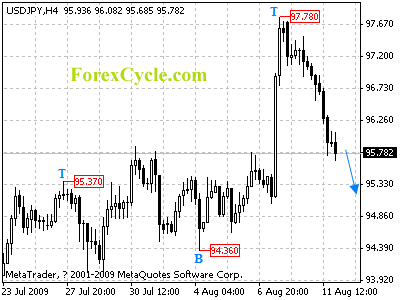
USDJPY drops sharply to as low as 95.69

USDJPY drops sharply to as low as 95.69, suggesting that a short term cycle top has been formed at 97.78 level on 4-hour chart. Deeper decline to 95.00 zone is expected in a couple of days. Initial resistance is at 96.10 followed by 96.35, as long as these levels hold, the short term downtrend from 97.78 will continue.

Read more...

DAILY FORECAST FOR USDCHF

Bias: 1.0775-90 is the break level although there is also support at
1.0733-58 but remain aware of both sides today

Breach of 1.0835 has undermined the strongly bullish scenario but we should be patient to allow confirmation of a reversal to develop. The key support is at 1.0790 - and also possibly 1.0775. Even then there is risk of a pullback. If we see an early correction back to the 1.0835-43 area that caps then any test of 1.0790 would more likely succeed and provoke stronger losses through 1.0733-58 and 1.0681 to reach the 1.0637 area. This should prompt a correction but in time the 1.0567 low will come under pressure.

Please view the complete analysis in the attached PDF file.

For a full description of how to use the analysis please see the Analysis page of my website. The prior day's set ups for potential trading levels highlighted in the report are now available on the Daily Forecast page of my web site.
Attached Files
File Type: pdf The Brief Daily Forecaster.pdf (23.1 KB, 0 views)

Read more...

SendMoneyHome.org is pleased to recommend the currency transfer services of World First

World First is one of the UK's leading currency exchange brokers, offering competitive exchange rates, fast international transfers and an exceptional service.

Whether you’re buying a property overseas, emigrating, sending money to relatives abroad or simply making a one-off transfer, you will have your own friendly and dedicated broker working on your behalf to save you money.

Our personal approach, coupled with our expertise and dedication sees clients return year on year to exchange billions of pounds.

Benefits of Using World First

  • Best ‘exchange rate guarantee’

  • Faster international payments (same day euro and dollar)

  • No commission and no bank receiving charges

  • Bespoke and professional service

  • Only broker to offer ‘currency options’

  • Free rate and market watch service

  • Available 24hrs a day through worldwide offices

Click to get a quote or visit the Wirdl First website

Read more...

FOREX Trader Video Tutorials

Tune in to our video tutorials to learn about key elements of our trading platform and products.

The FOREXTrader platforms combine ease of use and flexibility with a full suite of professional charting and order management tools. You can use the same User ID and Password to switch between platforms at will, putting you in total control of your trading.

Designed for active traders looking for an edge, this Windows-based platform offers a highly intuitive user interface, advanced customization features and a full suite of professional trading tools. With FOREXTrader, you can create and save multiple layouts and customize your workspace to fit your trading style.

Please turn on your speakers to view video tutorials.


Downloading FOREXTrader can be completed in three easy steps. Watch this tutorial to find out how.

Length: 00:48 seconds


Read more...

Forex Online Chat / Help

Chat With a Forex Specialist
CHAT WITH FOREX, TRADE EXPERT ONLINE NOW.
IT HELP U WITH THE VERY BEGINNING. CLICK ON IMAGE.

Read more...

$50,000 Forex Practice Trading Account

Experience the exciting world of currency trading with a free practice account. Register below for unlimited access to the FOREXTrader platform for the next 30 days, along with:

Real-time executable quotes in 37 currency pairs and spot gold · Powerful charting package for technical analysis · 24-hour news headlines, research and more

Test your strategies under real market conditions, with no risk and no obligation.


visit for FREE ACCOUNT

Read more...

How to read a spot gold quote

Reading a spot gold or silver quote is very similar to reading a forex quote. It is even represented the same way (for example, spot gold traded against the US dollar is XAU/USD).

In this example, it's simple if you remember three things:

XAU/USD 900.25
  1. The first symbol listed is 1 troy ounce of gold
  2. The value of gold is always 1.
  3. The price literally translates to; 1 ounce of gold is equal to 900.25 U.S. dollars.
When the price or quote for gold goes up, gold has strengthened in value and is now worth more dollars than before. If the price of gold goes down, it takes fewer dollars to purchase 1 ounce of gold, and the value of the dollar has increased when compared to the value of gold.

Bids, asks and the spread

Just like other markets, spot gold and silver quotes consist of two sides, the bid and the ask:

The BID is the price at which you can SELL.
The ASK is the price at which you can BUY.

The difference between the bid and ask prices is called the spread.

What does it all mean?

Spot gold and silver prices are quoted internationally in U.S. dollars per troy ounce. In this example, a quote of XAU/USD 900.25 means that 1 oz gold is equal to $900.25. If you buy a single lot of gold (1 lot = 10 oz) at this price and sell it at a higher price, your profit would be the difference between these two prices. In this way, trading spot gold on FOREX.com's trading platforms is nearly identical to trading currencies.

A typical quote you might receive for spot gold is 900.25/75. This means that you could sell one or more lot(s) of gold at 900.25, or buy at 900.75. The spread you would pay in this example would be the difference between these two prices (900.75-900.25) or 0.50.

The dollar amount represented by the change in price will depend upon the size of the trade you have placed. The smallest amount you can trade with FOREX.com is 1 lot, which represents 10 troy oz. At 1 lot, the smallest price change possible (0.01) is equivalent to $0.10.

Let's look at an example:

Let's say you decided to buy 1 lot of XAU/USD (spot gold) at 900.25.

A few minutes later, the bid (or sell) price has risen to 900.95, and you decide to exit your trade. You bought 1 lot at 900.25 and sold at 900.95, making 70 pips in the process. 70 pips, at $0.10 per pip, equal $7.00.
Now, let's say that we once again buy 1 lot of XAU/USD at 900.25.

A few minutes later, the bid (or sell) price has weakened to 899.60 and you decide to minimize your losses and sell the 1 lot of XAU/USD. The difference between buying 1 lot at 900.25 and selling 1 lot at 899.60 is 65 pips. 65 pips, at $.10 per pip, equals $6.50.

Pips or points, what's the difference?

Like forex prices, spot gold prices are quoted in tiny increments called pips ("percentage in point"). Located at the second decimal place for a spot gold quote, or 0.01, each pip represents 1 cent in dollar value.

Read more...

  © Blogger template PingooIgloo by Ourblogtemplates.com 2009

Back to TOP